
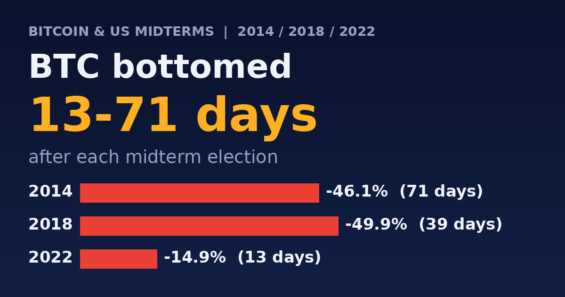
With the US midterm elections on November 3, a popular claim says bitcoin usually bottoms right after them. Daily closes from StatMuse show it held in the last three cycles, but with large further drops first.
| Election | Election-day close | Lowest close after | Drop | Days later |
|---|---|---|---|---|
| Nov 4, 2014 | $330.49 | $178.10 (Jan 14, 2015) | -46.1% | 71 |
| Nov 6, 2018 | $6,461.01 | $3,236.76 (Dec 15, 2018) | -49.9% | 39 |
| Nov 8, 2022 | $18,541.27 | $15,787.28 (Nov 21, 2022) | -14.9% | 13 |
Each of those lows also marked the bottom of that cycle. The midterm years themselves were weak: Binance Research puts the calendar-year declines at 56% in 2014, 73% in 2018 and 64% in 2022. Binance Research, as reported by 24/7 Wall St., adds that bitcoin gained 54% on average in the year after the midterms, based on three cycles. My own check of the closes gives +44.9% for 2018 to 2019 and +92.3% for 2022 to 2023, measured from election day.
The sample is tiny and the context differed: 2014 and 2018 were long bear markets, while the 2022 low came during the FTX collapse. Nothing here is a forecast.
Bitcoin trades near $77,000, about 39% below its October 2025 high of roughly $126,000, and it already hit $57,718 on July 1. Applied mechanically to $77,000, the 15% and 50% drops would mean about $65,600 and $38,600, but the July low already sits below the mildest case.
Track the market yourself with AiTraderView’s FREE tools: Crypto Cockpit for charts and 75+ indicators, Crypto Screener to find setups, and Crypto Portfolio to follow your holdings. Just create a FREE account and try them yourself!
Sources:
- StatMuse: Bitcoin price on November 4, 2014
- StatMuse: Bitcoin closing prices, January 2015
- StatMuse: Bitcoin closing prices, November 2018
- StatMuse: Bitcoin closing prices, December 2018
- StatMuse: Bitcoin closing prices, November 2022
- 24/7 Wall St.: Bitcoin Fell in Every Past Midterm Year and Rallied the Year After
⚠️ RISK WARNING & AI DISCLOSURE
- This information is generated by Artificial Intelligence (AI) and complex algorithms. While advanced, these systems can contain errors or inaccuracies and are for educational purposes only.
- Technical analysis provides no guarantees; this information is purely informative.
- All discussed scenarios are hypothetical and do not constitute predictions or expectations.
- Past performance is not an indicator of future results.
- This is not financial advice and is not intended as a call-to-action for the reader.
- No implicit direction is claimed, and no specific behavior of market participants is suggested.