
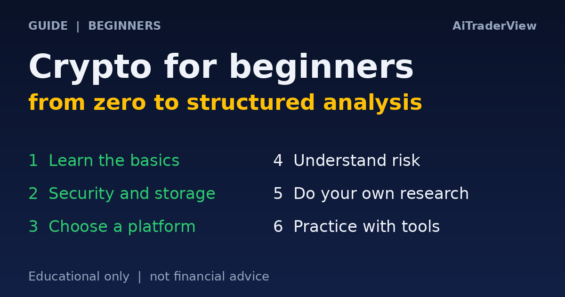
The crypto market can feel overwhelming for beginners. There are thousands of coins, complex charts and stories of quick profits everywhere. This guide walks through the basics step by step: what crypto is, how storage and security work, what to look for in a platform, how risk is limited and which tools you can use to learn analysis.
Disclaimer: this article is for educational and informational purposes only and is not financial advice. Cryptocurrencies are volatile and carry risk, including the loss of your entire investment. Always do your own research (DYOR) and contact a licensed adviser if needed.
Step 1: learn first, put money in later
Understand what crypto is before you look at trading or charts. Education and trading are two different things.
- Bitcoin is the first and best-known cryptocurrency. Some see it as digital scarcity or a form of saving, others as a speculative asset.
- Ethereum is a network on which smart contracts and applications run.
- Noise: thousands of other coins and meme coins exist. Many are promoted with promises of quick riches, such as “10x”. This guide covers only the basics and gives no opinion on individual coins.
Step 2: security and storage (custody)
- Custodial versus self-custody: with a custodial wallet, an exchange holds your coins. With self-custody you have full control, and also full responsibility.
- Private keys and seed phrases (recovery phrases) give access to your coins. Share them with nobody. No serious service ever asks for them.
- Scams: people who approach you through direct messages (DMs) on Discord, Telegram or Reddit with “investment advice” or “help” are almost always scammers.
- Cold storage: hardware wallets keep your keys offline and are an option for people who hold larger amounts for longer periods.
Step 3: choosing a platform
- Registration: check whether a platform is registered or licensed with the regulator in your country. In the EU the MiCA regulation applies, and in the Netherlands the AFM supervises. Also compare availability in your country and the platform’s reputation.
- Costs: look at trading fees, spreads and withdrawal fees. They differ per platform and per product.
- Advanced products: futures, leveraged products and trading bots are complex and can quickly lead to large losses. Studies show that many active traders lose money, partly because of liquidations and costs. Beginners often leave these products alone until they understand them well.
Step 4: understanding risk management
- Risky holding: crypto can fall sharply in value. Many people therefore only use money they can afford to lose.
- Dollar-cost averaging (DCA): this is a method where you buy in fixed steps, for example a fixed amount weekly or monthly. It spreads the moment of purchase and averages your purchase price, so you do not buy everything at one bad moment. The price still fluctuates, and DCA does not protect against loss.
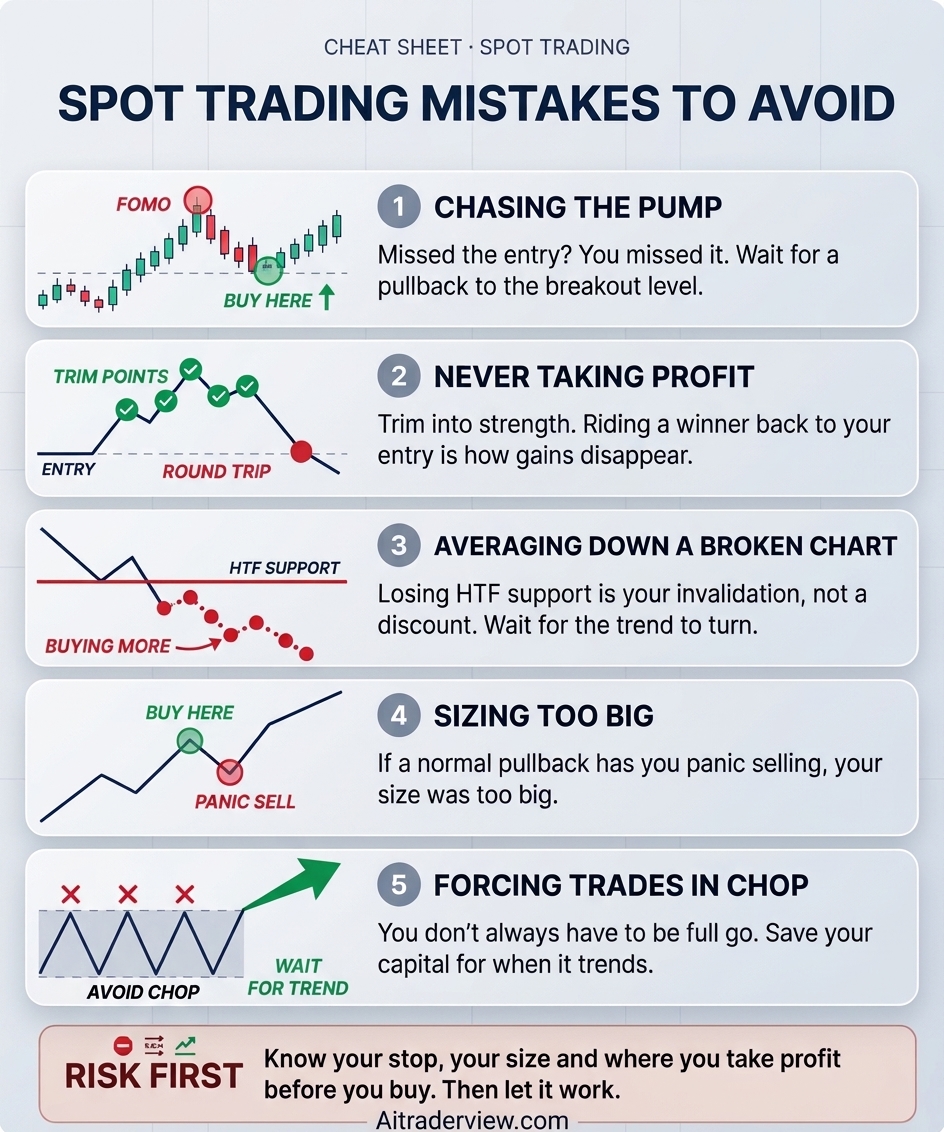
- Emotions: fear of missing out (FOMO) can lead to impulsive purchases, and fear during a decline to panic selling. A decline is already a loss on paper before you sell. Some people hold for a long time (HODL), others choose a different approach. Both carry risks.
- Tax: crypto can be taxable. Rules differ per country, so check with the tax authority in your country.
Step 5: learn to do your own research (DYOR)
- Be critical of influencers: they may have a stake in the coin they mention or be paid for a promotion. Check claims against multiple sources.
- Market cycles: study how markets and macroeconomic events influence prices, for example interest rate decisions by central banks. How markets will develop in the coming period cannot be predicted.
Step 6: tools to practice overview and analysis
Anyone who knows the basics and how to store assets securely can practice overview and analysis with tools. AiTraderView offers three free tools for this:
- Crypto Portfolio: you see your crypto holdings in one place, with the distribution and the value development. That is clearer than keeping your own spreadsheet, and it helps you look at your positions deliberately.
- Crypto Cockpit: a charting platform with 75+ technical indicators, such as RSI, moving averages and MACD. You can practice recognizing trends, support and resistance levels and patterns in historical price data, without putting money at risk.
- Crypto Screener: filters the market on criteria you set, such as market capitalization, trading volume or price change. This way you work with objective data instead of social media hype.
These tools do not give buy or sell advice. What you do with the data is up to you.
Conclusion
In the crypto world, what matters is structure, risk management and continuing to learn, not getting rich quickly. Anyone who works through these steps, from basic knowledge and secure storage to practicing with tools, is better able to make well-founded choices. Take your time and practice without risk. Knowledge helps you make better-informed choices.
Track the market yourself with AiTraderView’s free tools: Crypto Cockpit for charts and 75+ indicators, Crypto Screener to find setups, and Crypto Portfolio to follow your holdings.
⚠️ RISK WARNING & AI DISCLOSURE
- This information is generated by Artificial Intelligence (AI) and complex algorithms. While advanced, these systems can contain errors or inaccuracies and are for educational purposes only.
- Technical analysis provides no guarantees; this information is purely informative.
- All discussed scenarios are hypothetical and do not constitute predictions or expectations.
- Past performance is not an indicator of future results.
- This is not financial advice and is not intended as a call-to-action for the reader.
- No implicit direction is claimed, and no specific behavior of market participants is suggested.