LayerZero (ZRO) is a cryptocurrency project focused on connecting different blockchains. Its goal is to enable digital assets, data, and applications to communicate more easily across blockchain networks. With the development of the Zero blockchain and ATLAS, LayerZero aims to expand beyond cross-chain communication into infrastructure for payments and financial markets.
But what exactly is ZRO? How does its tokenomics work, how popular is the project, and what does its roadmap look like? This article examines the technology, token distribution, market sentiment, upcoming developments, and several possible scenarios for the next 6–12 months.
This article is for informational and educational purposes only. It does not constitute financial or investment advice. Cryptocurrencies are volatile, and the scenarios discussed below are illustrative rather than predictions.
What Is LayerZero (ZRO)?
LayerZero is an interoperability protocol that allows different blockchains to communicate with one another. Rather than treating every blockchain as an isolated ecosystem, LayerZero enables applications and digital assets to operate across multiple networks.
A practical example would be transferring stablecoins between different blockchains or building an application that serves users across several networks.
LayerZero focuses on several areas:
- Cross-chain communication between blockchain networks.
- The transfer and exchange of digital assets.
- Stablecoins and tokenized financial assets.
- Infrastructure for developers and financial institutions.
- New blockchain infrastructure through the Zero project.
More information is available on the official LayerZero website.
What Is the Purpose of the ZRO Token?
ZRO is the token associated with the LayerZero ecosystem. It plays a role in governance and is increasingly connected to the project’s economic activities.
One important component is the use of Stargate revenue to buy back ZRO on the open market. Stargate is a cross-chain application within the ecosystem. LayerZero has also announced plans to give ZRO a role within the Zero blockchain.
The precise economic significance of ZRO depends on how these plans are implemented, how much the network is used, and how much revenue its products generate.
Sources: The ZRO Token – LayerZero and ZRO Buybacks.
ZRO Tokenomics: How Many Tokens Exist?
Tokenomics is an important part of the LayerZero project. It provides insight into the maximum token supply, the distribution among different groups, and the rate at which additional tokens become available.
ZRO has a maximum supply of 1 billion tokens. According to the market data referenced for this article, approximately 399.2 million tokens were in circulation, representing around 39.9% of the maximum supply.
The circulating supply can change as tokens are unlocked, distributed, or reclassified by market-data providers.
Key ZRO Token Statistics
| Metric | Data |
|---|---|
| Maximum supply | 1,000,000,000 ZRO |
| Circulating supply | Approximately 399.2 million ZRO |
| Circulating percentage | Approximately 39.9% |
| Token launch | June 19, 2024 |
| Vesting schedule referenced | Through May 2027 |
Source: Tokenomics.com – LayerZero Unlocks.
How Are ZRO Tokens Distributed?
According to the ZRO whitepaper, the original allocation consists of the following categories:
| Category | Allocation |
|---|---|
| Community | 38.3% |
| Strategic partners | 32.2% |
| Core contributors | 25.5% |
| Repurchased tokens allocated to the community | 4.0% |
| Total | 100% |
This distribution shows that community participation is an important component of the project, while strategic partners and core contributors also hold substantial allocations.
Tokens allocated to investors and employees are released according to vesting schedules. As a result, the circulating supply and ownership distribution can change over time.
Source: ZRO Whitepaper via Bitstamp.
What Do ZRO Token Unlocks Mean?
A token unlock is an event in which previously restricted tokens become available under a vesting schedule. It does not automatically mean that the recipients will sell those tokens immediately.
According to the unlock calendar referenced for this article, approximately 31.25 million ZRO tokens are scheduled for release on October 20, 2026. The precise figure may differ between data providers, depending on their definitions and the treatment of previous distributions.
Three factors are particularly important when assessing an unlock:
- How many tokens actually become available.
- What proportion recipients choose to hold or sell.
- Whether demand for ZRO develops at a similar pace.
An increase in circulating supply can affect market dynamics. However, the eventual price impact also depends on trading volume, market sentiment, and how much of the event has already been priced in.
ZRO Buybacks: Is LayerZero Buying Back Its Own Tokens?
LayerZero operates a program in which revenue generated by Stargate is used to repurchase ZRO on the open market.
At the time of reference, the official buyback page reported approximately 2.38 million ZRO repurchased. This mechanism links part of the ecosystem’s revenue to demand for the token.
There is an important distinction between buying back tokens and burning them. A repurchased token does not automatically disappear from the total supply. Its eventual effect on available supply depends on what happens to the tokens after the buyback.
The separate protocol fee switch was also listed as inactive on the official buyback page. Therefore, completed buybacks should not be confused with potential future revenue streams that still depend on further protocol development.
Source: Official ZRO Buybacks Page.
Is ZRO Popular, and How Much Attention Does It Receive?
LayerZero is an established project within the blockchain interoperability sector. Its token is traded on cryptocurrency markets, and the project regularly publishes technical updates, product announcements, and information about its ecosystem.
Several factors contribute to the attention LayerZero receives:
- Growing demand for communication between blockchains.
- The use of cross-chain technology for stablecoins.
- Development of the Zero blockchain.
- The introduction of ATLAS for financial market infrastructure.
- The connection between Stargate revenue and ZRO buybacks.
Popularity can be measured in different ways. Trading volume, the number of token holders, developer activity, and social media mentions each provide a different perspective.
High trading volume, for example, does not necessarily mean that most market participants are positive about a project. It can also indicate speculation, uncertainty, or frequent trading.
Is Market Sentiment Positive or Negative?
The sentiment surrounding ZRO is best assessed by examining both the project’s positive developments and its risks.
Positive factors
- LayerZero addresses a practical technical problem: communication between blockchains.
- The organization is developing additional products and infrastructure.
- The buyback program connects part of Stargate’s revenue to the token.
- The expansion into Zero and ATLAS could create additional use cases.
Risks and concerns
- More tokens are still scheduled to enter circulation.
- The economic value of future products must be demonstrated in practice.
- LayerZero faces competition from other interoperability protocols.
- Technical problems and security incidents across the cross-chain sector can affect confidence in the industry.
Taken together, the project presents a mixed picture: there are tangible developments, but also meaningful uncertainties. Without a systematic analysis of recent posts on X, Reddit, and other social platforms, it is not possible to reliably determine whether the current online sentiment is predominantly positive or negative.
The LayerZero and ZRO Roadmap
The roadmap matters because future product launches, network usage, and revenue generation may influence the development of the ecosystem.
However, not every announcement represents a completed product. The timeline below distinguishes between completed milestones, publicly announced developments, and future plans.
2024: ZRO Token Launch
ZRO launched on June 19, 2024. Since then, the token has become part of the LayerZero ecosystem.
The launch enabled the token to be traded and marked the beginning of its ongoing tokenomics and governance development.
2025: Stargate Expansion and the Buyback Program
In 2025, LayerZero acquired Stargate, an application designed to transfer assets between different blockchains.
LayerZero subsequently announced a program that uses Stargate revenue to buy back ZRO. This created a more direct connection between activity within one of the ecosystem’s applications and demand for the token.
Source: Understanding ZRO Buybacks.
February 2026: Zero Announcement
In February 2026, LayerZero published technical documentation about Zero, a new blockchain designed around parallel execution and high transaction throughput.
The project targets applications where scalability, speed, and efficiency are important. Its architecture uses multiple execution zones and zero-knowledge technology to approach transaction processing and verification differently from traditional blockchain architectures.
Zero’s technical positioning includes ambitious scalability objectives. These should be distinguished from independently measured performance on a fully operational network.
Source: Zero – Technical Positioning Paper.
August 2026: Introduction of ATLAS
In August 2026, LayerZero introduced ATLAS, a financial market infrastructure project designed to combine trade execution, clearing, settlement, and risk management.
ATLAS is intended to build on Zero’s infrastructure and serve both open and institutional markets.
Its significance for ZRO will depend on implementation, actual adoption, and how the project’s economic activity is connected to the token.
Source: Introducing ATLAS.
September 2026: Further Ecosystem Development
In September 2026, LayerZero published updates concerning Stargate, testnet support, and security.
One important development is the announced transition under which Stargate transactions would be handled through Stargate Taxi from October 1, 2026. The project also announced plans to concentrate support on a selected group of test networks.
LayerZero’s bug bounty program for V2 was expanded to $3.5 million. The announced discontinuation of the V1 relayer program and its associated bug bounty is scheduled for December 15, 2026.
Source: LayerZero Ecosystem Update – September 15, 2026.
Late 2026: Zero, ATLAS, and Console
LayerZero’s official website identifies Zero and ATLAS as important parts of its ongoing product development. Console, a platform designed to manage and monitor multichain assets, is also part of the development agenda.
The website lists planned launches for certain products later in 2026. However, a definitive launch date for the complete rollout of every component has not been established by those announcements.
Key developments to monitor over the coming months include:
- Progress toward the launch of Zero.
- Actual adoption of ATLAS.
- Further development of Console.
- Growth in cross-chain transactions and stablecoin activity.
- Changes in revenue and completed ZRO buybacks.
Sources: LayerZero and LayerZero Resources.
2027: Completion of the Vesting Schedule
According to the referenced unlock calendar, the vesting schedule extends through May 2027.
This is an important milestone for tokenomics because it brings the end of the current vesting schedule into view. It does not mean that every token will automatically be sold or that no further changes to supply will occur afterward.
Changes in circulating supply and actual token distribution will therefore remain important indicators to monitor.
Source: Tokenomics.com – ZRO Unlock Schedule.
ZRO Scenario Analysis for the Next 6–12 Months
The development of ZRO depends on several factors. To illustrate possible outcomes, three scenarios can be considered: bearish, neutral, and bullish.
These scenarios are not price forecasts. They demonstrate how different assumptions about adoption and valuation could translate into possible token values.
1. Bearish Scenario
In a bearish scenario, LayerZero’s ecosystem expands more slowly than expected. Adoption of Zero and ATLAS remains limited, while market interest in higher-risk crypto assets weakens.
Possible developments include:
- Network usage grows more slowly than expected.
- Token unlocks increase the available supply.
- Buybacks are insufficient to offset selling pressure.
- The broader cryptocurrency market weakens.
Under these conditions, ZRO’s valuation could decline. A strong technological position does not automatically prevent a token’s market price from falling.
2. Neutral Scenario
In a neutral scenario, LayerZero continues expanding its ecosystem, but progress is gradual.
Possible developments include:
- Cross-chain usage increases without accelerating dramatically.
- Zero and ATLAS make progress, but their economic impact remains limited initially.
- Buybacks continue.
- The market balances growth expectations against future token releases.
Under these conditions, the valuation could remain relatively stable or move within a broad range. The outcome would depend on the relationship between adoption, token supply, and market sentiment.
3. Bullish Scenario
In a bullish scenario, LayerZero successfully deploys its new infrastructure and usage of its products increases substantially.
Possible developments include:
- Zero attracts developers and users.
- ATLAS develops into an actively used financial infrastructure platform.
- Cross-chain transactions and stablecoin activity increase.
- Revenue and completed buybacks grow.
- The market assigns a higher valuation to the ecosystem.
Under these conditions, ZRO’s market valuation could rise. However, this depends on measurable results and favorable market conditions. Announcements and prospective partnerships alone are not sufficient to establish that such an outcome will occur.
Illustrative Valuation Calculations
To make the scenarios more tangible, we can use fully diluted valuation, or FDV. This calculation divides a hypothetical valuation by the maximum supply of 1 billion ZRO.
| Illustrative FDV | Implied value per ZRO |
|---|---|
| $1 billion | $1 |
| $2 billion | $2 |
| $4 billion | $4 |
These are purely mathematical examples, not established price targets. The figures illustrate the relationship between valuation and token price.
The calculation uses the maximum supply and does not account for the precise future circulating supply, changing market conditions, or the possibility that the market assigns a different valuation to the project. An FDV of $4 billion also does not mean that $4 billion of capital has flowed into ZRO.
Which Factors Could Determine the Outcome?
The most important indicators to monitor are:
- Network usage: Are transaction numbers increasing, and is the infrastructure being used more extensively?
- Product launches: Are Zero, ATLAS, and Console actually being deployed and adopted?
- Token supply: How many tokens are being released, and how many ultimately enter the market?
- Buybacks: How much ZRO is repurchased using realized revenue?
- Market sentiment: Is the broader cryptocurrency market strengthening or weakening?
- Competition and security: Can LayerZero maintain its position and strengthen confidence in its infrastructure?
These indicators provide more insight into the project’s development than daily price movements alone.
Conclusion: What Is Next for LayerZero?
LayerZero is evolving from a blockchain interoperability protocol into a broader ecosystem with ambitions in blockchain infrastructure and financial applications.
ZRO has a maximum supply of 1 billion tokens. The buyback program connects part of Stargate’s revenue to the token, while future product launches could create additional use cases.
At the same time, token distribution, future unlocks, and the actual economic impact of new products remain important considerations. LayerZero’s ambitions are substantial, but the ultimate results will depend on adoption, revenue generation, and successful execution of its roadmap.
The next 6–12 months are particularly relevant to monitor because of the development of Zero, ATLAS, and Console, continued ecosystem growth, and changes in the available token supply.
The key takeaway: ZRO’s future depends not only on LayerZero’s technology but also on whether that technology is adopted at scale and generates measurable economic value for the ecosystem.
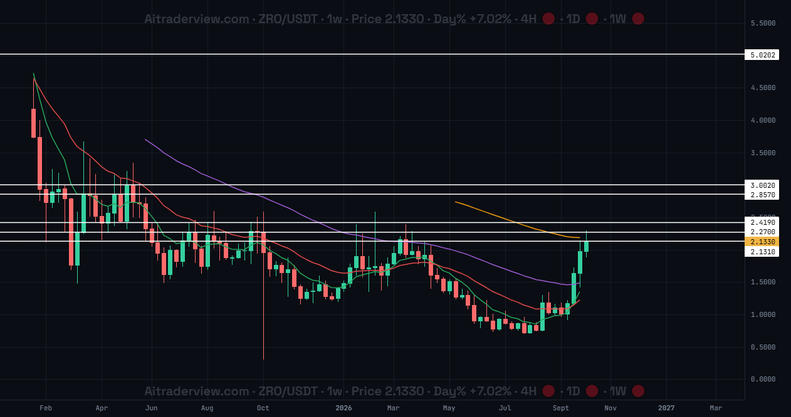
Track the market yourself with AiTraderView’s free tools: Crypto Cockpit for charts and 75+ indicators, Crypto Screener to find setups, and Crypto Portfolio to follow your holdings.
Sources and Further Reading
- Official LayerZero Website
- The ZRO Token
- Official ZRO Buybacks Page
- Zero Technical Positioning Paper
- Introducing ATLAS
- Ecosystem Update – September 2026
- ZRO Token Unlock Schedule
Disclaimer: This article is for informational and educational purposes only. It does not constitute financial advice, investment advice, or a recommendation to buy or sell any cryptocurrency. The scenarios and calculations presented are illustrative and do not guarantee future results. Cryptocurrencies can fluctuate significantly in value, and it is possible to lose some or all of the amount invested. Always verify current information using the original sources.
⚠️ RISK WARNING & AI DISCLOSURE
- This information is generated by Artificial Intelligence (AI) and complex algorithms. While advanced, these systems can contain errors or inaccuracies and are for educational purposes only.
- Technical analysis provides no guarantees; this information is purely informative.
- All discussed scenarios are hypothetical and do not constitute predictions or expectations.
- Past performance is not an indicator of future results.
- This is not financial advice and is not intended as a call-to-action for the reader.
- No implicit direction is claimed, and no specific behavior of market participants is suggested.