


Sui (SUI) is a Layer 1 blockchain developed by Mysten Labs. Its mainnet launched publicly on May 3, 2023. The network uses an object-centric data model and the Move programming language to support smart contracts, digital assets and decentralized applications.
The Sui ecosystem includes decentralized finance (DeFi), stablecoin payments, on-chain trading infrastructure, decentralized data services and Bitcoin-related financial applications. Recent announcements have covered gasless stablecoin transfers, a Sui-native stablecoin called Sui Dollar (USDsui), a Samsung Wallet integration for USDC, a high-throughput Sui-tunnel demonstration and the planned rollout of Hashi, a Bitcoin-collateral framework.
This article distinguishes documented network features from project announcements and future targets. It does not predict the market price of SUI.
This article is for informational and educational purposes only. It does not constitute financial advice or a recommendation to buy or sell any cryptocurrency.
What Is Sui (SUI)?
Sui is a Layer 1 blockchain designed to execute transactions and support applications involving digital assets and on-chain data.
A defining feature of Sui is its object-centric data model. Digital assets and other on-chain resources are represented as objects with defined ownership rules. Transactions involving independent objects can be processed in parallel when their dependencies permit it. Transactions involving shared state can require additional coordination.
Consequently, network throughput depends on the transaction types, application design and workload. A performance figure from one test should not automatically be treated as the throughput available to every application.
Smart contracts on Sui are written in Move, a programming language designed around resource-oriented handling of digital assets.
Applications and infrastructure associated with the Sui ecosystem include:
- Decentralized finance (DeFi): trading, lending, borrowing and liquidity provision.
- Payments and stablecoins: digital-dollar transfers and programmable payment applications.
- Gaming and consumer applications: applications involving digital assets and frequent interactions.
- On-chain trading infrastructure: including DeepBook, an on-chain order-book system.
- Decentralized data services: including Walrus, a decentralized data-storage network.
- Encryption and computation tools: including Seal and Nautilus.
- Bitcoin-related finance: Hashi, which is being developed to enable Bitcoin-backed financial applications using Sui.
These projects do not all have the same operator or development team. The Sui blockchain, Mysten Labs, the Sui Foundation and independent ecosystem projects are distinct entities.
Sources: Official Sui website, Sui token supply and schedule, DeepBook, Walrus.
What Is the Purpose of the SUI Token?
SUI is the native token of the Sui network. Its documented roles include transaction fees, staking and participation in the network’s economic mechanisms.
- Transaction fees: SUI is used to pay gas fees for on-chain transactions and computation. Supported stablecoin transfers can use Sui’s gasless-transfer feature, but this does not mean every transaction on Sui is free of gas fees.
- Staking: Sui uses delegated proof of stake. Token holders can delegate SUI to validators, which participate in operating the network. Staking rewards depend on network parameters and validator arrangements.
- Liquidity and applications: SUI can be used as a trading, liquidity or collateral asset in applications that support it. The role and amount of SUI used vary by application.
- Governance: SUI holders have rights to participate in Sui governance under the network’s rules.
These uses do not establish that increased network activity will automatically produce a proportional increase in demand for SUI. Network usage, token distribution, staking, fee mechanisms and market demand are separate factors.
Source: Sui tokenomics documentation.
SUI Supply and Tokenomics
SUI has a maximum supply of 10 billion tokens. Not all tokens were in circulation at mainnet launch. Sui’s official supply page states that roughly 5% were in circulation at that point, with the remainder intended to be released over time.
The release schedule is not a guarantee that all tokens will enter circulation on fixed dates. Sui states that the timing of future releases depends on how the Sui Foundation deploys its allocation to support builders and the ecosystem.
| Metric | Information |
|---|---|
| Maximum supply | 10 billion SUI |
| Mainnet launch | May 3, 2023 |
| Circulating supply at launch | Approximately 5% of total supply, according to Sui |
| Circulating supply (October 2026) | About 4.118 billion SUI (about 41.2%), according to Tokenomist and Tokenomics.com |
| Future releases | Governed by allocations and release schedules; timing can change |
Circulating supply, market capitalization and fully diluted valuation are time-sensitive figures. Data providers use different definitions and update at different times. The October 2026 supply figure above is attributed to the two trackers named and should be rechecked on the day of reading.
Sources: Sui token supply and schedule, Tokenomist, Tokenomics.com.
How Were SUI Tokens Originally Allocated?
The Sui Foundation published an initial allocation breakdown in December 2022. The published categories were:
| Category | Original allocation | Equivalent SUI |
|---|---|---|
| Community Reserve | 50% | 5 billion |
| Early contributors | 20% | 2 billion |
| Investors | 14% | 1.4 billion |
| Mysten Labs Treasury | 10% | 1 billion |
| Community Access Program | 6% | 600 million |
| Total | 100% | 10 billion |
The Foundation described this allocation as approximate and subject to change over time.
The Community Reserve was intended to support the network and its ecosystem through activities such as validator delegation, grants, education, research and development. The Community Access Program provided a route for community members to obtain SUI.
These figures describe the original allocation, not the number of tokens currently circulating or the amount currently held by each category. Later distributions and release schedules affect the status of the supply over time.
Sources: Sui Foundation: SUI Token Allocation, ForkLog report on the allocation.
What Are SUI Token Unlocks?
A token unlock makes previously restricted tokens eligible for release under a vesting or allocation schedule. After an unlock, recipients may hold the tokens, transfer them, stake them, use them in applications or sell them, subject to the relevant rules.
An unlock therefore does not mean that every released token is sold on the market. Nor does a scheduled unlock, by itself, establish the amount of selling pressure that will follow.
Third-party websites publish modeled SUI unlock calendars. Those models can differ in their dates, classifications and assumptions. A precise future unlock date or amount should therefore be attributed to the specific tracker and checked against its latest data.
Next modeled unlock
Tokenomics.com lists the next modeled unlock for November 3, 2026: 22,617,401 SUI, about 0.2% of the maximum supply. Tokenomist lists November 1, 2026, released to the Community Reserve. The two providers differ in dating and classification.
For current information, consult the official Sui supply page and compare it with the Tokenomics.com SUI unlock calendar and Tokenomist’s SUI unlock calendar.
The Storage Fund and Token Supply
Sui uses a Storage Fund to account for the long-term cost of storing data on the blockchain. Storage fees are part of transaction costs and are designed to help compensate for the resources required to maintain on-chain data.
The storage mechanism distinguishes between two parts:
- Refundable storage deposit: a portion is locked while an object exists. If eligible data is deleted or reduced, some of this deposit can be returned as a storage rebate.
- Non-refundable storage fee: this portion is permanently locked and is not returned to the user.
Immutable objects cannot be deleted or modified, so their storage deposit cannot be reclaimed through deletion. According to Sui, the non-refundable fees and the deposits for immutable objects permanently remove that SUI from circulation.
This mechanism should not be confused with a guarantee that the total circulating supply will decrease. Token releases can continue at the same time, and the net effect depends on multiple supply mechanisms.
Sources: Sui deflation page, Sui tokenomics documentation.
Gas Pricing and Sui Foundation Buybacks
Gas repricing
Sui’s revenue dashboard records a reference-gas-price reduction of roughly fivefold in April 2026. A lower reference gas price can reduce transaction costs, although actual fees depend on the transaction and network parameters.
On May 20, 2026, Sui also announced the launch of gasless transfers for supported stablecoins. This feature allows eligible stablecoin transfers to occur without the sender paying a separate SUI gas fee.
Sources: Sui network revenue and buybacks dashboard, Gasless stablecoin transfers announcement.
Buybacks
According to Sui’s buyback dashboard, the Sui Foundation uses stablecoin yield to buy SUI on the open market each day, on-chain. The purchased SUI is not burned. Sui states that it is distributed to network participants such as DeFi protocols, validators and other ecosystem partners, and that total supply is unchanged by the buybacks. Some monthly figures on the dashboard are estimates until rewards are recorded, so consult the dashboard for current values.
Source: Sui network revenue and buybacks.
Sui’s Technical Infrastructure
Several projects provide infrastructure for applications built around the Sui ecosystem. Their features should be considered separately from the core Sui blockchain.
- DeepBook: an on-chain central limit order book that provides trading infrastructure. It differs from automated market makers that use liquidity pools. Source: DeepBook.
- Walrus: a decentralized data-storage network associated with the Sui ecosystem. Source: Walrus.
- Seal: a system for encryption and access control. Source: Seal.
- Nautilus: infrastructure for verifiable off-chain computation. Source: Nautilus.
The existence of these tools does not mean that every Sui application uses them or that every feature is available in every application.
Stablecoins and Payments on Sui
Sui Dollar (USDsui)
Sui Dollar, commonly referred to as USDsui, was announced as a stablecoin for the Sui ecosystem and launched on mainnet on March 4, 2026, according to the project’s announcement.
The launch announcement identifies Bridge, a Stripe company, as the issuer. A stablecoin’s issuer and its underlying blockchain have different responsibilities: the issuer is responsible for the asset’s issuance and associated framework, while the blockchain processes supported transactions.
A launch announcement establishes that a product has been introduced. It does not, on its own, establish how widely the stablecoin is used, its current circulating supply or its market share.
Sources: Sui Dollar announcement, Sui Dollar launch.
Gasless stablecoin transfers
On May 20, 2026, Sui announced gasless transfers for supported stablecoins, including USDC and USDsui. The feature is designed to let users send supported stablecoins without separately holding SUI for the gas fee on an eligible transfer.
This feature applies to supported transfers, not necessarily every operation involving stablecoins. Other transactions, smart-contract interactions or application actions may still require gas.
Source: Sui launches gasless stablecoin transfers.
Samsung Wallet integration
On October 8, 2026, Sui announced a partnership with Samsung to bring USDC on Sui to Samsung Wallet. The announcement describes an initial rollout in the United States on eligible Galaxy devices, with expansion to other markets planned.
The announcement makes three distinctions important:
- USDC is the only supported asset at launch. The SUI token itself is not supported in Samsung Wallet under the announced integration.
- The 82 million figure refers to U.S. Galaxy devices cited in the announcement. It represents potential reach, not a count of active users of the new service.
- Sui’s stablecoin transfer-volume figure is a project-reported metric. Sui states that more than $1 trillion in stablecoin transfer volume has been processed since August 2025. Transfer volume is not the same as stablecoin supply, account balances or assets held on the network.
The partnership announcement establishes the planned integration, but it should not be taken as proof that every eligible device already has access to the service.
Source: Samsung and Sui announce USDC support for Samsung Wallet.
U.S.-Listed SUI Exchange-Traded Products
Several U.S.-listed investment products tied to SUI were launched between December 2025 and February 2026. Their structures and launch dates differ.
- 21Shares leveraged SUI ETF: launched in December 2025, offering 200% daily exposure through derivatives, according to Sui’s announcement about the later spot product.
- Canary Capital SUIS: the Canary spot SUI ETF with staking began trading on Nasdaq on February 18, 2026.
- Grayscale GSUI: Grayscale’s Sui Staking ETF launched on NYSE Arca on February 18, 2026. Sui describes staking as reflected in the fund’s net asset value.
- 21Shares TSUI: the 21Shares spot SUI ETF began trading on Nasdaq on February 24, 2026.
The 21Shares spot ETF therefore did not launch in the same week as SUIS and GSUI, and the leveraged product predates those February 2026 launches.
The existence of an exchange-traded product does not establish its assets under management, trading volume, investor demand or performance. Those details must be checked using the relevant fund disclosures and market data.
Sources: Canary SUIS announcement, Grayscale GSUI announcement, 21Shares TSUI announcement.
Network Reliability: January 2026 Outage
Sui’s official incident report states that the mainnet experienced a prolonged disruption on January 14, 2026. The problem involved a divergence in validator consensus processing, which prevented validators from certifying new checkpoints. Transaction submissions timed out during the incident.
Sui reported approximately six hours of disruption. The network resumed normal operation after engineers and validators deployed a fix and reprocessed consensus data.
According to Sui’s report, no certified state forks occurred, certified transactions were not rolled back and user funds were not put at risk. Those statements describe the incident according to the network’s own post-incident report.
The incident is relevant to assessments of network reliability, but a single outage does not establish the network’s future reliability or the probability of another incident.
Source: Sui Mainnet Network Stall Resolution.
Throughput Tests: What the TPS Figures Mean
On October 7, 2026, Sui announced that Sui tunnels processed 40,614,180 transactions per second during a live demonstration at Sui Basecamp in Singapore. Sui also reported a previous tunnel record of more than six million TPS on July 4, 2026.
These figures require context. Sui tunnels are programmable off-chain channels that settle to Sui mainnet when closed. During the October demonstration, more than 10,000 tunnels were opened, with example activities involving chat, games and payments. According to Sui, a tunnel needs two on-chain transactions, one to open it and one to close it, while intermediate activity takes place off-chain.
Therefore, the 40.6 million TPS figure describes the reported tunnel demonstration. It is not a measurement of sustained ordinary on-chain transaction processing at 40.6 million TPS.
Sui stated that independent auditor CertiK verified the demonstration in real time, and that CertiK would publish a report on its examination of the test data. A published CertiK report could not be confirmed in the sources checked for this article. The test result should therefore be attributed to Sui’s announcement rather than presented as an independently documented audit finding beyond what the available sources establish.
Sources: Sui’s October 7 throughput announcement, GN Crypto’s report on the tunnel test.
Post-Quantum Cryptography: Announced Development
On August 6, 2026, Sui announced work to add two standardized post-quantum signature schemes:
- ML-DSA-65: planned as a native signature scheme for everyday accounts.
- SLH-DSA-SHA2-128s: planned for use inside Move smart contracts for high-value vaults.
Sui’s published target schedule was:
- Quantum-safe vaults: targeted for mainnet in 2026.
- Native ML-DSA-65 accounts: targeted for testnet by the end of 2026.
- Native account authentication: targeted for mainnet in the first quarter of 2027.
Sui states that these features are intended to be additive and opt-in, and that existing accounts and applications are not expected to change automatically. The announcement also notes that post-quantum signatures and public keys are larger than conventional alternatives, increasing transaction size.
These are development targets, not confirmation that the features have already been deployed. Sui states that independent audits are underway and that the timelines remain open while that review and testnet feedback continue.
Source: Making Sui Quantum Ready.
Hashi: Bitcoin-Backed Finance on Sui
On October 8, 2026, Sui announced that Hashi’s mainnet would begin a phased rollout later that month. The announcement cited more than $500 million in capital commitments from a coalition of more than 20 companies.
Hashi is designed to support financial applications using Bitcoin as collateral while the underlying BTC remains on the Bitcoin network. According to Sui’s description, when BTC enters Hashi, hBTC is minted on Sui against the deposited Bitcoin. When a user exits, the corresponding hBTC is burned and the BTC is released back to the Bitcoin network.
The announced design includes the following elements:
- Collateral security: Sui says the system uses a 2-of-2 multisignature structure requiring authorization from Hashi validators and a guardian.
- Security review: Sui states that Hashi’s smart contracts underwent formal verification by Certora and that CommonPrefix reviewed the MPC protocol.
- Institutional access: Anchorage Digital was announced as a partner, with planned routes through its Atlas settlement infrastructure and Porto self-custody wallet.
- Third-party products: Sui describes Hashi as infrastructure developed by Mysten Labs, with financial products built and offered independently by third parties.
- Phased access: the announcement says access will expand as launch partners complete their integrations.
The distinction between committed capital and deployed capital is important. The announced $500 million represents commitments. The source does not establish that the entire amount has already been deposited into live Hashi applications or is currently being used in financial markets.
The October announcement describes a planned rollout, not proof that all integrations or financial products were already available at the time of publication.
Source: Hashi mainnet announcement.
Fully Diluted Valuation: What Does It Measure?
Fully diluted valuation (FDV) is a calculation based on a token’s price and its maximum supply.
FDV = Token price × Maximum token supply
For SUI, the maximum supply used in this calculation is 10 billion tokens. At a hypothetical price of $1 per SUI, the corresponding FDV would be $10 billion.
Market capitalization typically uses circulating supply rather than maximum supply. The two figures can differ substantially when a large portion of the maximum supply has not yet entered circulation.
FDV and market capitalization are valuation metrics. Neither represents the amount of cash invested in a token, and neither guarantees that the token could be sold at the quoted price across its entire supply.
Source for maximum supply: Sui token supply and schedule.
Which SUI Metrics Should Be Tracked?
Different measurements answer different questions. They should not be used interchangeably.
| Metric | What it measures | Source |
|---|---|---|
| Circulating supply | Tokens reported as circulating under a provider’s methodology | Sui supply page |
| Unlock schedule | Modeled or announced future token releases | Tokenomics.com |
| Network revenue and buybacks | Reported gas fees, stablecoin yield and SUI purchases | Sui dashboard |
| DeFi total value locked (TVL) | Assets deposited in supported DeFi protocols | DefiLlama |
| Network incidents | Reported incidents and service status | Sui status page |
| Product releases and roadmap targets | Officially announced launches and planned milestones | Sui blog |
Stablecoin transfer volume, stablecoin supply, DeFi TVL, circulating token supply and capital commitments measure different things. A large transfer-volume figure does not necessarily mean that the same amount of stablecoins is held on the network. A capital commitment does not necessarily mean that the capital has been deposited or deployed. A roadmap announcement does not establish that a product is already live.
Conclusion
Sui is a Layer 1 blockchain with an ecosystem covering smart contracts, DeFi, payments, stablecoins and data infrastructure. Its native token, SUI, is used for network fees, staking and other functions in the ecosystem, and its maximum supply is capped at 10 billion tokens.
Several developments are documented as launched, including Sui’s mainnet, Sui Dollar, gasless transfers for supported stablecoins and U.S.-listed SUI investment products. Other developments discussed here, such as the Samsung Wallet rollout, Hashi’s phased mainnet rollout and post-quantum account support, should be understood according to the status and timing described in their announcements.
The October 2026 tunnel test reported a very high off-chain throughput figure, but that result should not be confused with sustained throughput for ordinary on-chain transactions. Similarly, announced capital commitments, planned integrations and token release models should not be treated as proof of actual usage, deployed capital or future market performance.
These facts describe the network, its tokenomics and announced developments. They do not establish a future price for SUI.
Below you can find screenshots of the analysis from Crypto Cockpit, our free crypto analysis tool. Create a free account and generate your own analysis. Crypto Cockpit supports more than 59 languages and offers 50+ unique indicators that you won’t find anywhere else.
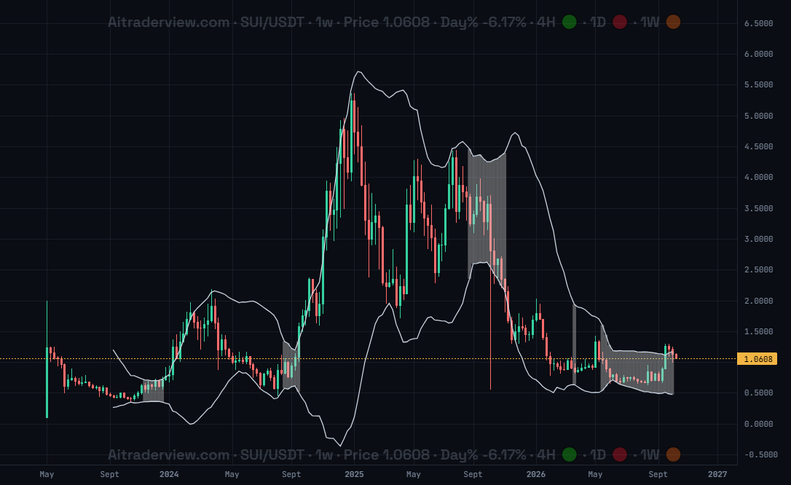
- SUI is in a Weekly Squeeze and tries to breakout
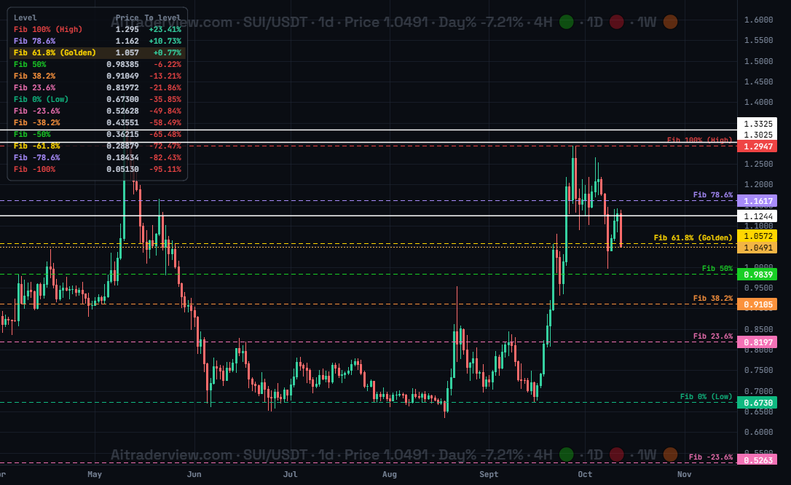
- SUI is testing on a Daily timeframe the Fibonacci golden pocket
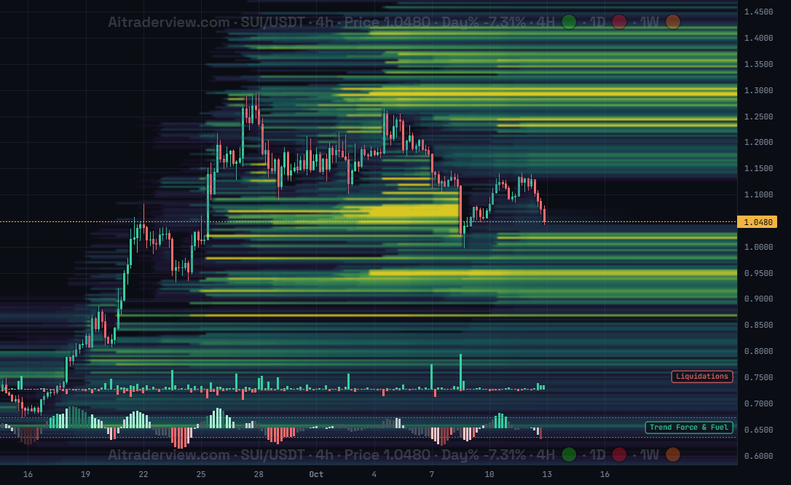
- Is SUI going to make a Liquidity grab on the 4h timeframe?
Sources and Further Reading
- Sui official website
- SUI token supply and schedule
- Sui tokenomics documentation
- Sui deflation
- SUI Token Allocation (Sui Foundation, December 2022)
- ForkLog: Sui token distribution
- Sui revenue and buybacks dashboard
- Sui Dollar announcement
- Sui Dollar launch
- Gasless stablecoin transfers
- Samsung Wallet and Sui
- Canary SUIS announcement
- Grayscale GSUI announcement
- 21Shares TSUI announcement
- Sui network-stall incident report
- Sui tunnel throughput announcement
- Making Sui Quantum Ready
- Hashi mainnet announcement
- Tokenomics.com SUI unlock calendar
- Tokenomist SUI unlock calendar
Disclaimer: This article is for informational and educational purposes only. It does not constitute financial advice, investment advice or a recommendation to buy or sell any cryptocurrency. Cryptocurrency prices can fluctuate significantly, and losses are possible. Supply figures, market data and third-party unlock models can change. Announced milestones are not necessarily completed deployments. Consult the linked sources for the latest status and data.
⚠️ RISK WARNING & AI DISCLOSURE
- This information is generated by Artificial Intelligence (AI) and complex algorithms. While advanced, these systems can contain errors or inaccuracies and are for educational purposes only.
- Technical analysis provides no guarantees; this information is purely informative.
- All discussed scenarios are hypothetical and do not constitute predictions or expectations.
- Past performance is not an indicator of future results.
- This is not financial advice and is not intended as a call-to-action for the reader.
- No implicit direction is claimed, and no specific behavior of market participants is suggested.