
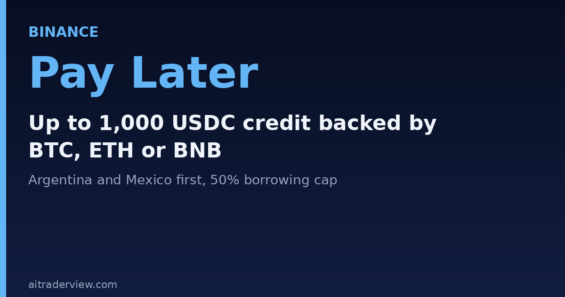
Binance said on Monday it will offer eligible users in Argentina and Mexico up to 1,000 USDC in spending credit through Pay Later, a payment feature backed by their cryptocurrency holdings. Users can borrow against Bitcoin, Ether or BNB without selling the underlying assets, and spend the credit through Binance Card or QR Pay.
Borrowing is capped at 50% of the eligible collateral’s value, so $2,000 in BTC is needed to reach the maximum $1,000 credit line. Purchases are interest-free until the repayment deadline on the first day of the following month. Binance’s published FAQ lists a one-day grace period and interest of 0.1% per day, compounding daily, on overdue balances.
The feature carries market risk. Falling prices can put the pledged holdings at risk, and Binance can liquidate collateral once the outstanding loan reaches 90% of its value, even before repayment is due.
The launch starts in Argentina and Mexico, with a gradual rollout planned for more markets. Thomas Gregory, Binance’s VP of payments and fiat, said traditional consumer credit often relies on income documentation and credit history, which leaves people who hold assets but have no formal credit file with fewer options, and that asset-backed credit offers an alternative.
Track the market yourself with AiTraderView’s FREE tools: Crypto Cockpit for charts and 75+ indicators, Crypto Screener to find setups, and Crypto Portfolio to follow your holdings. Just create a FREE account and try them yourself!
Sources:
⚠️ RISK WARNING & AI DISCLOSURE
- This information is generated by Artificial Intelligence (AI) and complex algorithms. While advanced, these systems can contain errors or inaccuracies and are for educational purposes only.
- Technical analysis provides no guarantees; this information is purely informative.
- All discussed scenarios are hypothetical and do not constitute predictions or expectations.
- Past performance is not an indicator of future results.
- This is not financial advice and is not intended as a call-to-action for the reader.
- No implicit direction is claimed, and no specific behavior of market participants is suggested.