
KPI: DPC (Dominance Price Correlation)
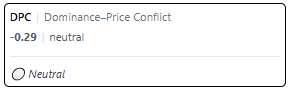
Analyzing Market Share: The DPC (Dominance Price Correlation)
The DPC (Dominance Price Correlation) is an analytical metric that measures the statistical relationship between an asset’s price (typically Bitcoin or Ethereum) and its market dominance. While standard indicators focus solely on price action, the DPC analyzes whether a price move is supported by a corresponding change in market share.
This data assists analysts in determining if a trend is driven by the specific asset outperforming the market, or if capital is rotating between sectors.
1. What is DPC?
DPC calculates the correlation coefficient between price changes and changes in market dominance over a specific lookback period. It addresses the analytical question: “Is this price movement aligned with the asset’s relative market share?”
- Dominance: The percentage of the total crypto market capitalization held by a specific asset.
- Correlation: The statistical degree to which price and dominance move in the same direction.
2. Interpreting the Data States
The DPC uses color-coded statuses to visualize the relationship trend:
🟢 Positive Correlation (Price & Dominance Rising)
- Technical State: Price is rising while market dominance increases.
- Interpretation: This indicates that the asset is outperforming the broader market. In market theory, this is often interpreted as Capital Concentration, where the market leader (e.g., BTC) attracts liquidity at a faster rate than alternative assets.
🔴 Negative Correlation / Divergence
- Technical State: Price is rising, but market dominance is falling.
- Interpretation: This “conflict” signals that while the asset is gaining value, it is losing market share relative to others. This is technically known as Capital Rotation (flow into Altcoins) or a trend driven by broad market liquidity rather than asset-specific demand.
⚪ Neutral / Balanced
- Technical State: No significant statistical correlation is detected.
- Interpretation: Price and dominance are moving independently, or the market is in a consolidation phase.
3. Critical Market Scenarios
| Scenario | Price | Dominance | Status | Market Context |
| Capital Concentration | 📈 Up | 📈 Up | 🟢 Positive | Price rally supported by market share expansion. |
| Capital Rotation | 📈 Up | 📉 Down | 🔴 Divergence | Asset is rising, but underperforming the broader market (Altcoins gaining). |
| Flight to Quality | 📉 Down | 📈 Up | 🟠 Warning | Asset is falling, but slower than the rest of the market (Defensive behavior). |
| Broad Liquidation | 📉 Down | 📉 Down | 🔴 Negative | Capital is exiting the asset and the sector simultaneously. |
4. Integration with MMS V2
Within the MMS (Market Macro Score) algorithm, the DPC serves as a logic filter for trend validation:
- Signal Quality: The MMS algorithm checks DPC status to categorize trends. A rally supported by positive dominance correlation is classified differently than a speculative rotation rally.
- Leading Indication: A shift in DPC (e.g., from Positive to Divergent) is monitored by the system as a potential signal of trend exhaustion or rotation, often appearing before price structure breaks.
5. Why Monitoring DPC is Essential
Analyzing dominance correlation provides context to price movements.
- Identifying Divergences: Helps users spot scenarios where price rises are not supported by market share growth.
- Asset Allocation: Provides data to inform decisions on whether to position portfolios towards market leaders (BTC) or alternative assets, based on rotation signals.
Educational Concept: Altcoin Seasonality
Traders often monitor the DPC-BTC for signs of “Alt-season.” In market cycle theory, a scenario where Bitcoin is in an uptrend but DPC turns Negative (Red) is interpreted as a signal that capital is rotating into riskier assets (Altcoins). Historically, if Bitcoin corrects while Dominance is low, the broader market may experience increased volatility.
⚠️ RISK WARNING & AI DISCLOSURE
- This information is generated by Artificial Intelligence (AI) and complex algorithms. While advanced, these systems can contain errors or inaccuracies and are for educational purposes only.
- Technical analysis provides no guarantees; this information is purely informative.
- All discussed scenarios are hypothetical and do not constitute predictions or expectations.
- Past performance is not an indicator of future results.
- This is not financial advice and is not intended as a call-to-action for the reader.
- No implicit direction is claimed, and no specific behavior of market participants is suggested.